F18 - Risk of Material Misstatement Content
The following describes the feature included in probe audit premium+.
Instructions:
Watch the video for detailed guidance on the feature above, then read the summary below for a concise overview.
1. Objective of ROMM
The risk of material misstatement refers to the risk that the financial statements are materially misstated and do not present a true and fair view of the client’s financial position.
You must identify and assess the risks of material misstatement, whether due to fraud or error, at the financial statement and assertion levels, through understanding the client and its environment, the applicable financial reporting framework and the client’s system of internal control, thereby providing a basis for designing and implementing responses to the assessed risks of material misstatement.
Having obtained and documented an understanding of the client including its system of internal control, you are in a position to identify and assess the risks of material misstatement, which is done at the financial statement level, and at the assertion level for classes of transactions, account balances and disclosures.
The aim of the risk assessment process is to provide a basis for designing and performing further audit procedures.
2. Components of ROMM
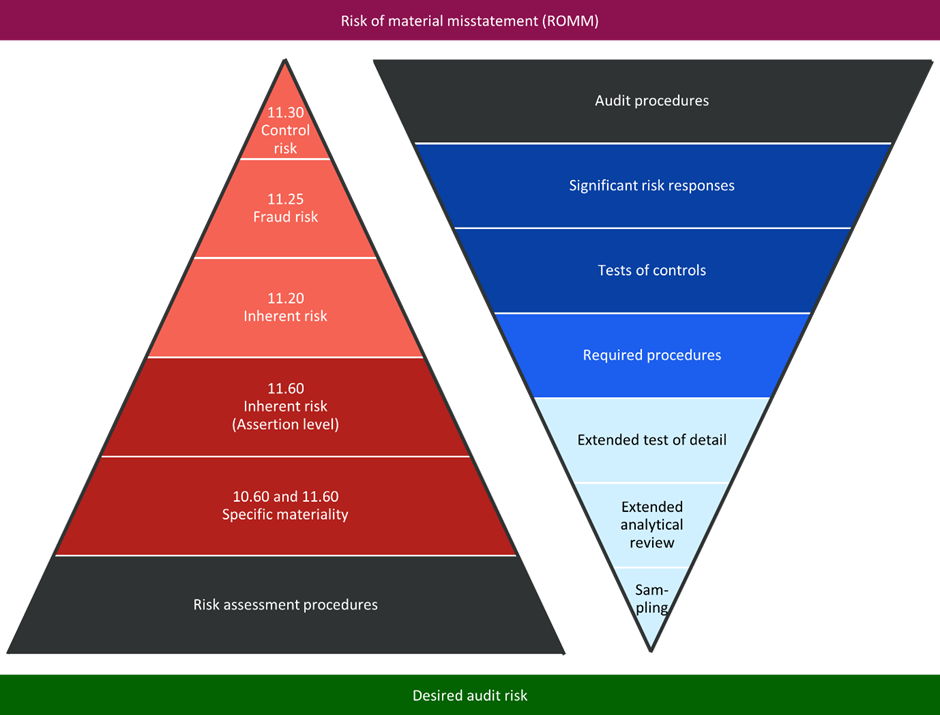
The Risk of Material Misstatement (ROMM), in the Probe Audit Premium+ methodology, is made up of the following:
| Relevant document | Components included in ROMM |
| 11.60 Risk assessment at assertion level | Specific materiality for the line item |
| 11.60 Risk assessment at assertion level | Risk assessment at assertion level for inherent risk |
| 11.20 Inherent risk assessment | Risk assessment at financial statement level for inherent risk |
| 11.25 Fraud risk assessment | Risk assessment at financial statement level for fraud risk |
| 11.30 Evaluation of system of internal control | Risk assessment at financial statement level for control risk |
You can obtain one of the following levels of ROMM:
| Maximum |
| Very high |
| High (3) |
| High (2) |
| High (1) |
| Medium (3) |
| Medium (2) |
| Medium (1) |
| Low |
| Very low |
| Minimum |
3. Risk assessment at financial statement level
The engagement team considers whether the risk at financial statement level is sufficiently addressed through the overall responses or whether the extent of substantive procedures must be increased to sufficiently respond to the inherent risk, fraud risk or control risk at financial statement level.
When you determined that an increase in the extent of substantive procedures is required to respond to financial statement level risks, the assessed inherent risk, fraud risk or control risk at financial statement level will be included in the ROMM calculation in the audit engagement file.
When you determined that the selected overall response(s) are sufficient and appropriate without the need to increase the extent of substantive procedures, the inherent risk, fraud risk and control risk at financial statement level will be included at a low level in the ROMM calculation.
4. ROMM for a material COTABD
When a Class of transactions, Account balance or Disclosure (COTABD) is material – in other words exceeds specific materiality – and all the other risks are low, you will have a risk of material misstatement (or ROMM) of at least Medium (1) for the relevant and selected assertions. You will thus never have a ROMM of Minimum, Very Low or Low for COTABDs that are above specific materiality as this causes a situation which could be interpreted that no audit work is required for the relevant and selected assertions of a material COTABD.
5. Respond to ROMM
After determining the ROMM you need to design and perform procedures to lower your ROMM to your level of Desired Audit Risk.
The desired audit risk is the subjectively determined risk that you are willing to take that the financial statements are not fairly presented after the audit is completed and an unqualified opinion has been reached. The lower the desired audit risk, the more sure you want to be that the financial statements are not materially misstated and the more work would be performed during the audit.
In Probe Audit Premium+ the desired audit risk is set in document 10.20 - Engagement evaluation, see page 10.20-1.
Your response to ROMM can include the following:
| Audit procedures | When it is used to respond to ROMM |
| Significant risk response | Significant risk responses are required when a significant risk has been recorded for a relevant assertion. |
| Tests of control | Tests of control are required when you want to place reliance on one or more controls that address a relevant assertion. |
| Required procedures | Required procedures are activated for the relevant or selected assertions relating to:
1 General required procedures;
2 Laws and regulations;
3 Estimates; and
4 Transactions relating to account balances (TRABs). |
| Extended test of detail | You can choose to perform extended tests of detail, extended analytical review or sampling (or a combination of these procedures) to reduce the remaining risk of material misstatement to the level of desired audit risk. |
| Extended analytical review |
| Sampling |
Rate this article:
|vote=None|
Processing...
(Popularity = 1/100, Rating = 0.0/5)
Related Articles
Probe | Respond to ROMM at assertion level (relevant assertions) and selected assertion for material COTABD
Probe Audit | 11.60 - Risk Assessment At Assertion Level
Probe | In 12.20, why is my inherent, fraud and control risk at financial statement level assessment showing "blank" or "Not yet assessed"?
Probe | Plan risk assessment procedures related to COTABDs and resources to be used
view all...
Search Results
Guide ZA-Signatories Form
Guide ZA-Liability Form
Easy Add-ons User Guide
Firm Template Guide Latest Version
Caseware Time | How to Add a VAT amount on an Invoice?
view all...